

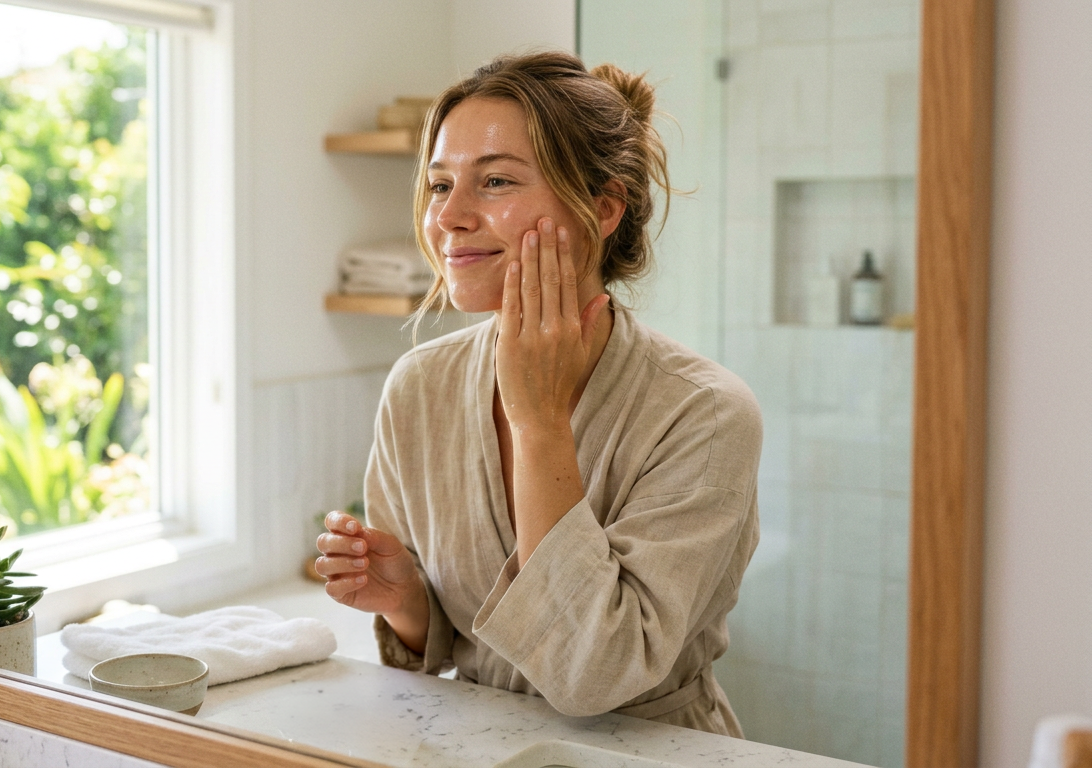
The Missing Step in Most Summer Skincare Routines
By Sejal Patel, PharmD
One of the more interesting conversations I have during the summer usually begins the same way.
Someone tells me their skin feels dehydrated.
What makes those conversations interesting is that many of these individuals are already using moisturizer. In fact, some are using excellent moisturizers. Yet their skin still feels tight by the afternoon, less comfortable than usual, or somehow unable to maintain the balance it seemed to have just a few months earlier.
As a pharmacist, those situations tend to make me curious because they suggest there may be a disconnect between the problem someone is experiencing and the solution they're using.
Over the years, I've found that many people think about hydration as a single step. If skin feels dry, the instinct is often to reach for a richer moisturizer or apply more of it. While moisturizer certainly plays an important role, I've never viewed hydration as something that begins and ends with a single product.
In many ways, hydration is a process. And sometimes the reason skin continues to feel dehydrated has less to do with the moisturizer being used and more to do with what happens before it.
Why Moisturizer Isn't Always the Answer
One of the challenges in skincare is that we often use the words "dry" and "dehydrated" interchangeably, even though they don't necessarily mean the same thing.
Dry skin refers to a skin type. Dehydration is a temporary condition in which the skin lacks sufficient water. Someone with oily skin can experience dehydration just as easily as someone with dry skin.
This distinction becomes particularly important during the summer.
Heat, sun exposure, travel, air conditioning, changes in routine, and even disrupted sleep can influence how hydrated the skin feels. Many people find that a routine that worked perfectly well during the spring suddenly feels less effective by July. Their first assumption is often that they need a heavier moisturizer.
Sometimes that's true. Often, however, I think it's worth taking a step back and looking at the entire routine rather than focusing on the final step alone.
One of the things I learned during my years in gastroenterology is that healthy systems rarely depend on a single factor. They're usually the result of multiple processes working together. The more I studied skin, the more I found myself returning to that same principle.
What Happens After Cleansing Matters
When people think about hydration, moisturizer tends to get most of the attention.
What receives far less attention is the period immediately after cleansing.
I've always found that interesting because cleansing is one of the few moments in a skincare routine when we have the opportunity to actively prepare the skin for what comes next.
After cleansing, the skin is free of sunscreen, makeup, excess oil, and environmental buildup. At the same time, it is also in a position to receive hydration and support. What happens during those next few minutes can influence how the skin feels throughout the rest of the day.
This is one reason I became interested in hydration layering.
The concept is actually quite simple. Rather than relying on a single product to deliver all of the hydration the skin needs, hydration is supported throughout the routine. Lightweight hydration is introduced first, followed by products designed to help maintain and support that hydration.
When people begin thinking about hydration this way, the conversation shifts. Instead of asking, "Which moisturizer should I use?" they begin asking, "How can I better support hydration throughout my routine?"
I think that's often a more useful question.
Understanding the Role of Essence
If there is one category that continues to generate questions, it is essence.
People frequently ask whether it is a toner, a serum, or simply an extra step that can be skipped. I understand the confusion because the category is often explained in different ways.
The way I think about essence is much simpler.
I think of it as a hydration bridge.
After cleansing, the skin is prepared to receive hydration. Before treatment products and moisturizer are applied, an essence helps introduce lightweight hydration while helping prepare the skin for the rest of the routine.
That was the thinking behind Replenishing Essence.
Featuring rose damascena, licorice root, and rice extract, it was developed to support hydration and skin comfort while fitting naturally into a daily routine. In clinical evaluation, Replenishing Essence demonstrated a 47% increase in dermal hydration within 10 minutes of application.
While that result is exciting, what I find most meaningful is what it represents. Hydration influences far more than how skin looks. It contributes to comfort, supports normal barrier function, and helps create the conditions that healthy-looking skin depends upon.
For me, that is where the real value of hydration lies.
Supporting Skin, Not Chasing Symptoms
One of the reasons I became interested in skincare after years in gastroenterology is that I kept seeing many of the same themes appear in both fields.
Healthy barriers matter. Balanced microbiomes matter. Hydration matters. The body's ability to appropriately respond to stress matters.
The more I learned about skin, the more I came to view it as a system rather than simply a surface. When skin feels dry, irritated, or uncomfortable, my instinct is rarely to ask how we can force it to change. Instead, I find myself asking what the skin might need in order to function better.
That perspective eventually became the foundation for Plantkos.
Our formulations are independently evaluated for hydration support, skin compatibility, barrier integrity, and microbiome friendliness because those are the areas that continue to shape how I think about skin health. Rather than focusing on quick fixes or aggressive approaches, we've always been more interested in supporting the systems responsible for healthy-looking skin in the first place.
The Missing Step
If your skin has felt dehydrated this summer despite using moisturizer, it may be worth considering whether hydration is being supported throughout your routine or only at the very end of it.
Sometimes the solution isn't another treatment product.
Sometimes it's a better understanding of what the skin needs after cleansing and before everything else.
Thoughtful hydration, much like healthy skin itself, is often built through consistency rather than intensity.
This month, receive a complimentary full-size Gentle Exfoliating Gel Cleanser with purchases of $75 or more and discover how thoughtful cleansing and hydration layering work together to support healthy-looking summer skin.
Share:
Copper Peptides and Skin Resilience: A Multi-Pathway Approach to Structural Skin Support